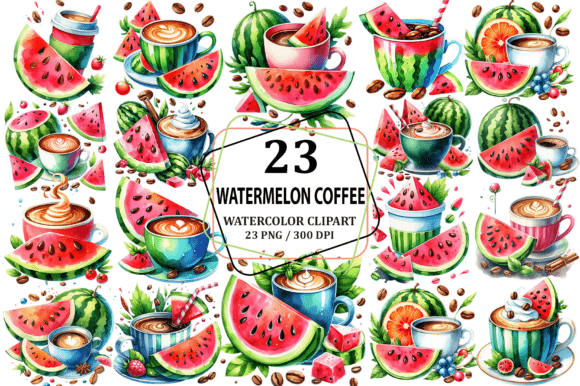
Watercolor Watermelon Coffee Cup Clipart for Branding and Design
If you have spent any time browsing creative marketplaces or building visual content for social media, you have likely noticed a shift toward illustrated, hand-painted design assets. Among the most versatile options available right now is Watercolor Watermelon Coffee Cup Clipart. This set combines the soft, organic texture of watercolor painting with a playful, recognizable subject: a refreshing watermelon-themed coffee cup. It is the kind of asset that immediately signals warmth, creativity, and approachability, whether you are designing a summer menu or building a brand identity from scratch.
Unlike rigid vector icons or generic stock photography, this clipart brings a handcrafted feel to digital and print projects. The watercolor technique introduces natural variation in opacity, color saturation, and edge softness—qualities that are difficult to replicate with standard design tools. For creatives who want to stand out without spending hours illustrating from scratch, this type of asset offers a practical shortcut to a polished, original look.
What Makes Watercolor Watermelon Coffee Cup Clipart Stand Out Visually
The visual personality of this clipart is rooted in contrast. You have the bold, recognizable silhouette of a coffee cup—a familiar object in daily life—rendered in the loose, unpredictable medium of watercolor. The watermelon motif adds a layer of seasonal association and playfulness. The pink-red gradients, subtle green rind accents, and occasional seed details create a composition that feels both deliberate and spontaneous.
This clipart typically appears in high-resolution PNG format with transparent backgrounds, which means you can place it directly onto existing layouts, product mockups, or digital canvases without additional masking work. The watercolor texture means no two renderings look exactly the same, giving each design a unique, hand-painted character. For brand identity work, this can be a powerful way to communicate authenticity and craftsmanship without using an actual photographed object.
The style leans toward modern illustration rather than photorealism. It is not trying to look like a photograph of a coffee cup. Instead, it embraces the medium—visible brush strokes, color blooms, and soft bleeds. This makes it especially effective for projects where you want to convey a handmade, small-batch, or artisanal vibe.
Where This Clipart Works Best Across Creative Projects
Because of its versatile subject and aesthetic flexibility, Watercolor Watermelon Coffee Cup Clipart fits into a surprising range of applications. Below are the most effective uses based on real-world design needs.
Branding and Logo Design
For coffee shops, juice bars, cafes, and summer pop-ups, this clipart can serve as a primary or secondary logo element. The watermelon connection works especially well for seasonal branding campaigns. If you are designing a brand identity for a small business that serves cold brew or fruit-infused coffee, this asset gives you a ready-made visual anchor. Pair it with a clean sans serif font for the business name, and you have a cohesive look without needing to commission custom illustration.
One practical consideration: because watercolor textures do not scale perfectly to very small sizes, use this clipart at medium to large sizes in your brand materials. It works beautifully on packaging, signage, and website hero sections, but less effectively on tiny social media avatars or favicons where the texture details are lost.
Packaging Design
Packaging is where this clipart truly shines. Coffee bags, cold cup sleeves, takeaway boxes, and gift tags all benefit from the organic, appetizing look of watercolor. The watermelon theme suggests freshness, summer, and indulgence—qualities that resonate well in food and beverage packaging. You can place the clipart prominently on the front of a product or use it as a repeating pattern on interior packaging materials.
If you are a small business owner creating your own product labels, this clipart eliminates the need to hire a professional illustrator. You can download the set, adjust your layout in a tool like Canva or Photoshop, and produce professional-looking packaging in a single afternoon.
Social Media Graphics and Digital Content
For bloggers, content creators, and social media managers, Watercolor Watermelon Coffee Cup Clipart is a reliable asset for posts, stories, and banners. It works particularly well for summer content series, recipe posts, lifestyle photography overlays, and promotional graphics. The watercolor style adds a tactile, analog feel to digital spaces, which can help your content stand out in crowded feeds dominated by clean vector graphics and stock photos.
Use it as a central graphic element in an Instagram post announcing a new summer drink, or layer it with handwritten script typography for a quote graphic. The clipart also works well as a background element when placed at low opacity behind text.
Editorial and Print Publishing
Magazines, zines, recipe books, and seasonal catalogs benefit from the inclusion of this clipart. If you are a publisher or editor working on a summer issue, this asset can be used in article headers, pull quotes, section dividers, or recipe cards. The hand-painted quality adds visual interest without overwhelming the page layout. Pair it with a modern serif font for body text to create a balanced, readable editorial design.
One observation from real editorial use: watercolor clipart works especially well on uncoated paper stocks where the natural texture of the paper complements the brush-like appearance of the artwork. If you are printing on glossy coated paper, you may want to add a subtle texture overlay to maintain the handcrafted feel.
Personal and Craft Projects
Hobbyists and crafters will find this clipart useful for scrapbooking, card making, journal covers, party invitations, and DIY decor. Because it is digital, you can resize it, recolor it, or combine it with other design assets without degrading the quality. For Etsy sellers creating printable planners, stickers, or wall art, this clipart can serve as a recurring visual motif across a product line.
How Clipart Influences Visual Hierarchy and Brand Perception
Incorporating Watercolor Watermelon Coffee Cup Clipart into your designs does more than just decorate a page. It actively shapes how your audience perceives your brand. The organic, fluid edges of watercolor communicate approachability and creativity. In contrast, rigid geometric shapes or polished vector icons often feel more corporate or formal. If your brand voice is friendly, playful, or artisanal, this clipart reinforces that message at a subconscious level.
From a visual hierarchy standpoint, watercolor clipart works best as a focal point or accent element rather than a background texture. Because the edges are soft and the color saturation varies, it naturally draws the eye. Place it in a position of prominence—such as the center of a product label or the top of a social media post—to anchor the viewer's attention. Then use cleaner typography and negative space to guide the viewer through the rest of the content.
Consistency is another factor. If you use this clipart across multiple touchpoints—your website, packaging, social media, and print materials—you build visual recognition. Audiences begin to associate the watercolor watermelon coffee cup with your brand identity, which strengthens recall over time. This is especially valuable for small businesses competing against larger competitors with bigger design budgets.
Practical Guidance for Choosing and Using This Clipart
Before you download and start designing, take a moment to evaluate whether this clipart fits your specific project. Here is a checklist to guide your decision.
Evaluate Project Fit
Ask yourself: does the watermelon theme align with my brand or content theme? If you are designing for a winter coffee campaign or a formal corporate brand, this clipart may feel out of place. However, if you are working on anything related to summer, refreshment, casual dining, or creative lifestyle content, it is a strong fit. The coffee cup element makes it relevant to coffee and cafe brands, while the watermelon twist adds a unique angle.
Test Pairings with Typography
Typography choices matter when using illustrated clipart. Because the watercolor style is organic and slightly unpredictable, pairing it with a clean, stable sans serif font often works best. A modern sans serif like Montserrat, Lato, or Proxima Nova provides contrast without competing for attention. If you want a more playful feel, try a handwritten script font that echoes the hand-painted quality of the clipart. Avoid pairing it with heavy serif fonts or overly decorative display fonts that create visual clutter.
For font pairing in logo or header designs, consider using a premium display font for the main wordmark and a simple sans serif for supporting text. This creates a clear visual hierarchy where the clipart and the typography each have their own role.
Review Included File Styles and Formats
Not all clipart sets are created equal. Check what file formats are included before purchasing. The most useful options are high-resolution PNG files with transparent backgrounds, SVG files for scalability, and EPS or AI files for vector editing. Some sets also include variations in color, orientation, or detail level. Having multiple versions of the same design gives you flexibility across different media. If you plan to use the clipart in web design, ensure the file size is optimized for fast loading without sacrificing quality.
Consider Readability and Scalability
As mentioned earlier, watercolor textures lose detail when scaled down too small. For practical purposes, use this clipart at a minimum size of roughly 200 pixels in any dimension for digital use, and at least 1 inch in print. Below those thresholds, the texture may read as noise rather than intentional brushwork. For small-scale applications like favicons or watermark stamps, consider using a simplified vector version of the design if available.
Check Commercial Licensing
If you are a designer, entrepreneur, or small business owner planning to use this clipart in products for sale—such as printed t-shirts, coffee bags, or digital templates—verify the commercial license terms. Some clipart sets restrict the number of copies you can produce or require attribution. Others offer unlimited commercial use. Reading the license terms upfront saves you legal headaches later. Most marketplaces clearly label whether an asset includes commercial rights, but it is always worth double-checking before launching a product line.
Final Observations on Working with Watercolor Assets
Design assets like Watercolor Watermelon Coffee Cup Clipart represent a broader trend in modern typography and visual design: the return of handmade, imperfect, human-centered aesthetics. In a digital landscape saturated with AI-generated imagery and cookie-cutter templates, hand-painted clipart offers a way to reintroduce warmth and personality. It is not about rejecting technology, but about using it selectively to amplify the human touch.
For marketers, bloggers, and publishers, this approach translates into higher engagement. Audiences respond to visuals that feel genuine and crafted rather than mass-produced. A watercolor coffee cup on a product page or social media post invites the viewer to pause, look closer, and connect with the content on an emotional level. That pause—that moment of visual curiosity—is often the difference between a scroll and a conversion.
Whether you are designing a brand identity, packaging a product, or creating content for your blog, this clipart gives you a head start. It is a versatile, professional-grade asset that respects your time while elevating your results. Pair it with thoughtful typography, use it at the right scale, and apply it consistently across your materials. The result will be a cohesive, memorable visual presence that feels as good as it looks.